COP17: Global Leaders Launch Action Framework to Combat Sand and Dust Storms
 Ч.Сумъяабазар
08 сарын 25, 2026

ULAANBAATAR, Mongolia — International delegates and government leaders convened in the Action Dome at UNCCD COP17 on August 25, 2026 for a Special High-Level Event on Sand and Dust Storms (SDS). The event featured high-level policy declarations, country-level commitments, and the official release of the Secretary-General’s framework for action under the UN Decade on Combating Sand and Dust Storms (2025–2034).
Host Nation Urges Action at the Source
Representing the COP17 presidency, B.Munkhtamir, Deputy Minister of Environment and Climate Change of Mongolia, highlighted the severe ecological shift in the host nation.
"Over the past 35 years, number of dust storms has increased by two to five days in some parts of our country, with certain areas now experiencing between five and 40 such days a year. These figures are clear call for action." — B.Munkhtamir, Deputy Minister of Environment and Climate Change of Mongolia.
Mongolia highlighted the joint launch of the Initiative on Strengthening Transboundary Cooperation for Sand and Dust Storms alongside ESCAP and the Trilateral Cooperation Secretariat (TCS) to bolster regional warning systems and risk management.
UN Leadership Drives the Decade Agenda
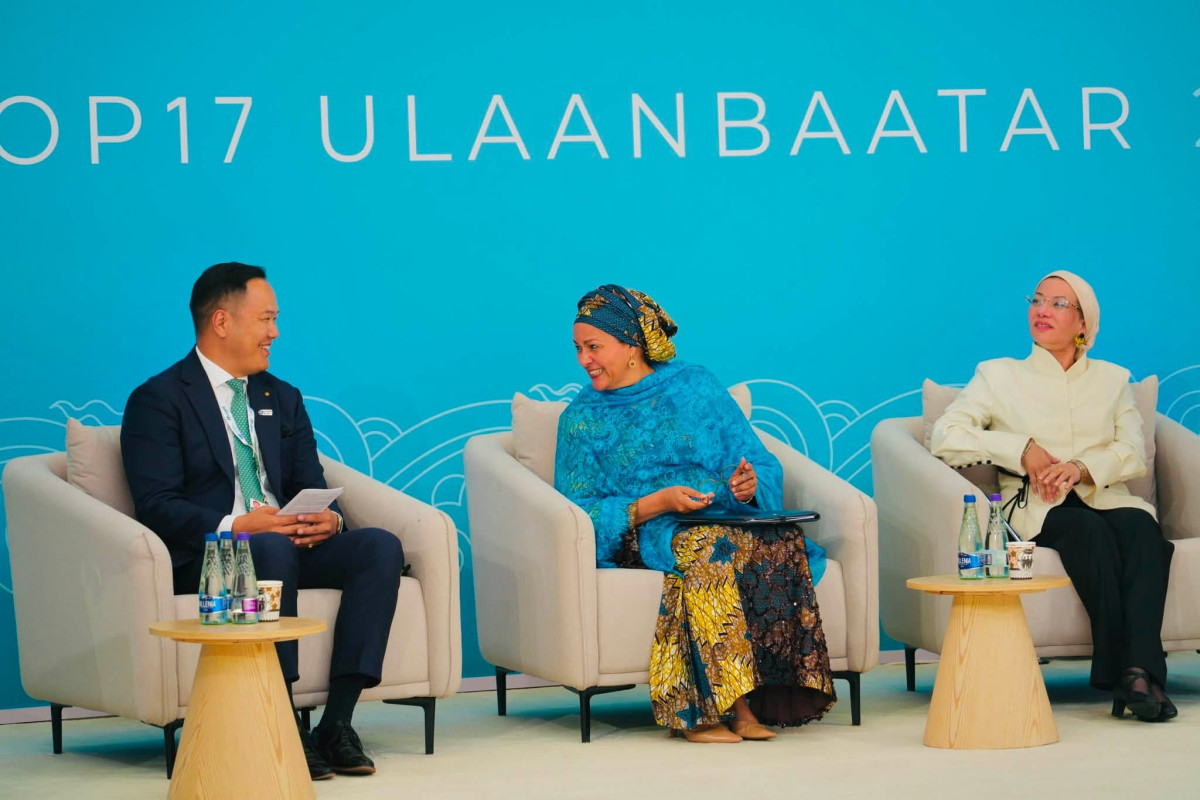
UN Deputy Secretary-General Amina J. Mohammed formally presented the Secretary-General's framework for action, detailing the expanding geographic footprint of land degradation and shifting storm patterns.
"Yesterday, we heard a statistic that should stop us in our tracks, that the share of land affected by desertification and degradation here in Mongolia has soared from around 65 to 81%. UNCCD data tells us a similar tale, showing that the number of sand and dust storms days has tripled since the 1990s. The desert is encroaching, the land is losing resilience, and communities are paying the price. But this is not Mongolia's story alone. Across our world, sand and dust storms affect hundreds of millions of people, more than 150 countries." — Amina J. Mohammed, Deputy Secretary-General, United Nations
UNCCD Executive Secretary Dr. Yasmine Fouad focused on atmospheric impacts, private sector investment, and source mitigation solutions.
"The number of sand and dust storm that goes to the atmosphere each year is two billion tons. That is around 350 size of the pyramids of the Giza where I come from. You can see here the eternal blue sky as they say here in Mongolia, but that's not the case in other parts of the world." — Yasmine Fouad, Executive Secretary, UNCCD
Regional Investment and Cooperation Highlighted
Delegates from Northeast and East Asia highlighted structured governance systems, regional cooperation initiatives, and cross-border partnerships:
China: Mr. Li Danbo, Director General of the Academy of National Forestry and Grasslands, detailed China's long-term framework:
"Since 1978, the Chinese government has advanced desertification prevention and control through the three North shelter forest program and the suit of ecological initiatives... notably the desertification provision and control law which took effect in 2002 and the eco environment code enforced in 2026." — Li Danbo, Director General, Academy of National Forestry and Grasslands, China
Republic of Korea: Director General Lee Kwang Ho of the Korean Forest Service highlighted Korea's investments and Nature-based Solutions:
"The Republic of Korea is no exception, remaining directly in the path of these severe storms. Every spring, the improved yellow and dust, yellow dust and sandstorms into the Korean Peninsula threatens our citizens respiratory health and their livelihoods. Beyond the public health, it causes significant economic damage with production disruptions in our advanced semiconductor industry, paralyzing air logistics and and dampening commercial and retail markets. Recognizing the severity of the sand and dust storm issue, the Republic of Korea has been striving to mitigate sand and dust storms and restore ecosystems through the Korean-Mongolia Green Belt Project. Over the past 20 years, Korea and Mongolia have created a total of 3,000 hectares of forest in areas such as Lun and Dalanzadgad." — Lee Kwang Ho, Director General, Korean Forest Service, Republic of Korea
Building on joint commitments established at the 2024 Trilateral Cooperation Secretariat (TCS) Summit among China, Japan, and the Republic of Korea, key participating entities formally launched the Mongolia–TCS–ESCAP Joint Initiative on Addressing Sand and Dust Storms in North-East Asia. As noted by ESCAP Executive Secretary Armida Salsiah Alisjahbana, this joint mechanism operates under the "Trilateral Plus X framework" alongside ESCAP and the TCS. The initiative establishes a structured institutional framework designed to connect source-area ecological restoration directly with cross-border early warning networks, technical sharing, and coordinated regional risk management across affected nations.
Холбоотой сэдвүүд
Санал болгох